Wednesday, November 20, 2013

Putting together an e-Learning course


Say your boss/professor/business partner comes to you and asks for you to put together a brief e-Learning course. Before you cue the sweat and tears, there are a handful of helpful tips that may help prepare for such a task that sounds grueling, but actually can be tackled and finished with some easy preparation.

1. Create a training template

This step is especially key for those who are pressed on time and eager to get their course ready to go for their user. Using simple templates that lay out objectives in a structured format can do wonders. Make sure to include a section for learning evaluation as well.

2. Create models for learner's interaction

No one wants to sit at a desk top and click on double sided flash cards to learn (I'm talking to you, pesky marketing professor!). Instead, bring a level of open ending thinking with the learner. Less drag and drop, more real world based questions and issues raised to get them thinking on their toes. Look at past tactics that have proven successful in your own field of study, and apply them here.

3. Create a themed template

The look and feel is just as important as the content itself when talking about user interface. So, here, instead of sticking to a basic PowerPoint format of bullets and key info points (quel amateur), using different programs such as Articulate Presenter can be a more engaging and creative experience for the end user. (See: http://articulate.www.resources.s3-website-us-east-1.amazonaws.com/community/president/player.html)

4. Create clip art/images 


Taking advantage of images that fit the style of the overall theme you're going for in a course layout is advantageous for the visual learner. You can pull these from various clip art sources, your computer, or make them yourself on a design program. Building a collection early on can offset the pain of rigorously trying to scour the internet for semi-application photos and gifs that may or may not fit in your "presentation".

5. Create questions to ask

Come up with some pre-determined questions to ask before putting together the e-Learning course. Make sure they are well thought out, meaningful, and geared towards the main objectives. This will aid in helping design the overall course.


And voila, there you have it. Simple as cake, and I'm sure y'all are headed to put together your own e-Learning course as we speak.


Any other suggestions that you think would bode helpful, please comment them below.


Sources:
Kuhlmann, Tom. "5 Ways to Jump Start Your Next E-learning Project - The Rapid ELearning Blog." The Rapid ELearning Blog RSS. N.p., 2 July 2007. Web. 20 Nov. 2013.

Images. Articulate.com

Tuesday, November 19, 2013

Challenges with MOOCs

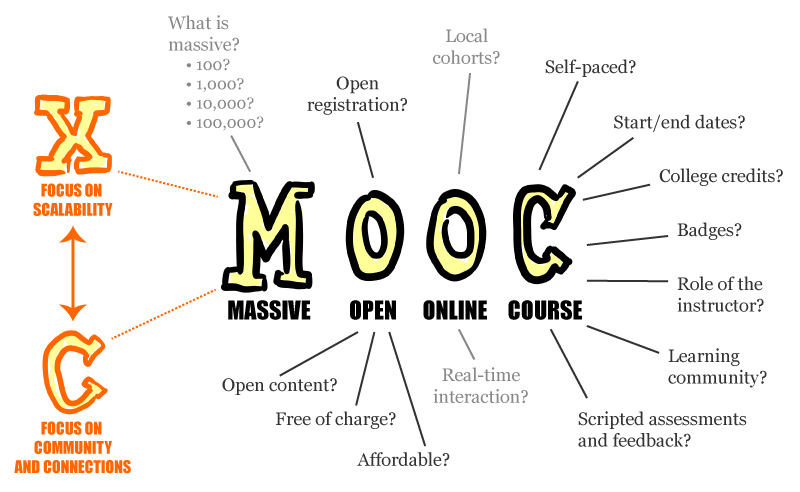
As MOOCs is on the rise. It will have its supporters and its critics. I found an article which discusses the benefits and challenges of a MOOC. I want to discuss the challenges it lists:

1.       It feels chaotic as participants create their own content
2.       It demands digital literacy
3.       It demands time and effort from the participants
4.       It is organic, which means the course will take on its own trajectory (you have got to let go).
5.       As a participant you need to be able to self-regulate your learning and possibly give yourself a learning goal to achieve.

Looking at the list of challenges, it shows they all have the similarity on the user being self-reliant. Users create their own content, it demands time and effort, and self-regulation to name a few again. These are reasonable concerns, and to the average person who hasn’t even taken a normal course online, this may be overwhelming. This may be a drawback for MOOCs and cause potential users to not engage in it. There are also many learners who just aren’t self-motivated, especially for a course that is required and not personally chosen. Giving yourself a learning goal to achieve, as mentioned in #5 may not be realistic for most classes seeing that majority of people have one goal which is to pass.
Although, like I said before, these are reasonable concerns; anyone looking to take a MOOCs course should expect a few things off of this list. Someone who is not digitally literate, per se, should probably not be opting for such a course, but maybe the more traditional setting. Someone else, on the other hand, like your more tech savvy student, should already be expecting these things and should have no problem moving along in a MOOCs course.
        Do you feel that these challenges are enough to stunt the growth of MOOCs? Do you feel like these are reasonable concerns? Are there any other challenges that you think such a massive online course could bring?


Who creates eTraining platforms?


Virtual eTraining is a European company that provides a platform for businesses to provide training and learning to their colleagues. They push for customized learning, reusing you existing documentation to save money, and developing courses based on specific needs. They use a Learner Management System (LMS) as reporter and user administration to provide the company with information about who is participating, what they are training, and their progression on each course. With iPads and tablets sales skyrocketing businesses are leaning more towards mobile training, so the company is staying current by developing software and programs that will run on iOS and other devices. The company provides a film crew that will allow the company to work alongside the team in creating videos for their colleagues to have a more interactive training experience. 
These concepts are all surrounding the technological advancements in the workplace that focus on driving down costs for businesses. Virtual eTraining has created a 360-degree technology program that gives the user the most interactive and cost effective experience to better service employees.

Well This is New... eTraining for Dogs?


eTraining has proven to be useful for training even outside of the workplace. This website is for dog trainers, owners, and enthusiast looking to train their dogs through watching interactive videos, blogs, lectures, and modules. Users can train their dogs at the own pace, and use what they decide are best practices for their canine. Courses are available for anyone who has access to the Internet and users can blog about their own experiences with their dog. People post situations they think other owners might come across or just feedback from implementing one of the courses. Dog owners receive knowledge about health care, grooming, and dog fitness. Participants can pay by class, and they offer the training equipment all on one site. There are hundreds of different classes for owners to choose from, because there is no one way to train your pet. I found this article interesting because it is an untraditional way of training a dog. You don't have to take your dog to the same site/class every time and you can train the dog at your pet's pace. The evolution of technology has allowed this interactive experience and people don’t have to pay hundreds of dollars for a dog trainer or to take a private class.  eTraining for dogs saves owners money just like it saves money for businesses to train colleagues online, so I think that in the future we will see more traditional training classes available online for the masses to access.


http://www.e-trainingfordogs.com

Wednesday, November 13, 2013

The Evolution of Workplace Training

Recently I started a job that had the most pointless training class. I received stacks and stacks of paper and I have not looked at it or even thought about it since I got hired and started working; half of the training is in a face-to-face class, and half of the training is online. The company I work for has even been on the news for their excessive paper usage in training classes, so now they are gradually moving to the eTraining method of orientation for new colleagues. What led to this change? The topics in this article explain why companies are migrating towards the eTraining method, and the trends in training that got human resource managers using this new technology to teach new workers. Challenges for training include different training styles, generation gaps, and other cultural barriers so moving to a more generational-friendly method of training is becoming a best practice for firms. eTraining methods are easier to update, they move quicker, and information is available at any time on a self-paced basis. These characteristics align with our ever-changing technological culture.

http://ehstoday.com/training/evolution_workplace_training

Sunday, November 10, 2013

The Growth of MOOCs


“Over a little more than a year, Coursera in Moutainview, California – the largest of three companies developing and hosting massive open online courses (MOOCS) – has introduced 328 different courses from 62 universities in 17 countries (left). The platform’s 2.9 million registered users come from more than 220 countries (center). And courses span subjects as diverse as pre-calculus, equine nutrition and introductory jazz improvision (right).”

From the data I have posted above, we can all see how diverse and large MOOCs is growing to be. This has to be because it is efficient. MOOCs is fairly new; it became relevant to academia in the summer of 2011. Through some reading I have found out more about MOOCs and its growth.

According to Waldrop, The ferment is attributable in part to MOOCs hitting at exactly the right time. Bricks-and-mortar campuses are unlikely to keep up with the demand for advanced education: according to one widely quoted calculation, the world would have to construct more than four new 30,000-student universities per week to accommodate the children who will reach enrolment age by 2025 (see go.nature.com/mjuzhu), let alone the millions of adults looking for further education or career training. Colleges and universities are also under tremendous financial pressure, especially in the United States, where rocketing tuition fees and ever-expanding student debt have resulted in a backlash from politicians, parents and students demanding to know what their money is going towards.

This gives me reason to believe that MOOCs is only going to continue growing in the steady pace seen above in the chart to the left as time goes on. How do you feel about this? Do you like this idea? Or would you rather continue with a traditional learning environment?
 

Friday, November 8, 2013

ARE WE REALLY ALL THAT MOTIVATED IN THE CLASSROOM?

As I sit through majority of my classes, it never fails to amaze me the level of extracurricular activities going on with students. I must admit that I have also been guilty of the occasional 'cat-nap' during class, but then I have a 40 hour workweek in addition to the 12 credit hours I am taking. However when I see fellow students playing poker online, texting, watching videos on Youtube, shopping; most online activities you can name; it begs the question...'How focused are we in the classrooms as college students?' Most of us would agree that the benefits of traditional classrooms far outweigh the online setting, but are we reaping the most out of these benefits if we are not really in-tuned with the learning going on in class. The bigger question is why most students don't feel motivated to focus and interact with the teacher in class? This article brings up some interesting points about what causes the lack of motivation and focus and what teachers can do to try and conquer the issue.  http://www.facultyfocus.com/articles/effective-teaching-strategies/motivating-students-with-teaching-techniques-that-establish-relevance-promote-autonomy/. I know for me, the lack of focus at times is simply out of exhaustion but for the rest of us, what are our reasons?